

Does Your Business Really Need Full Automation — Or Just One System That Actually Works?
Why solo operators keep burning time on automation they don't need — and what to do instead.
By Stephanie | DigiBrix Consulting
The Question Nobody Actually Answers
Here is the scenario I see more often than anything else.
A small business owner decides they are going to use AI to streamline operations. They start reading. They watch videos. They follow a few people online who show beautifully connected systems — workflows that hand off from one tool to the next, inboxes that sort themselves, follow-ups that send automatically, client onboarding that runs without a human touching it. The whole architecture looks clean, modern, and finally, manageable.
Six weeks later, they have three half-built integrations, a Zapier account with eleven zaps that sometimes work, and somehow more things to maintain than they had before.
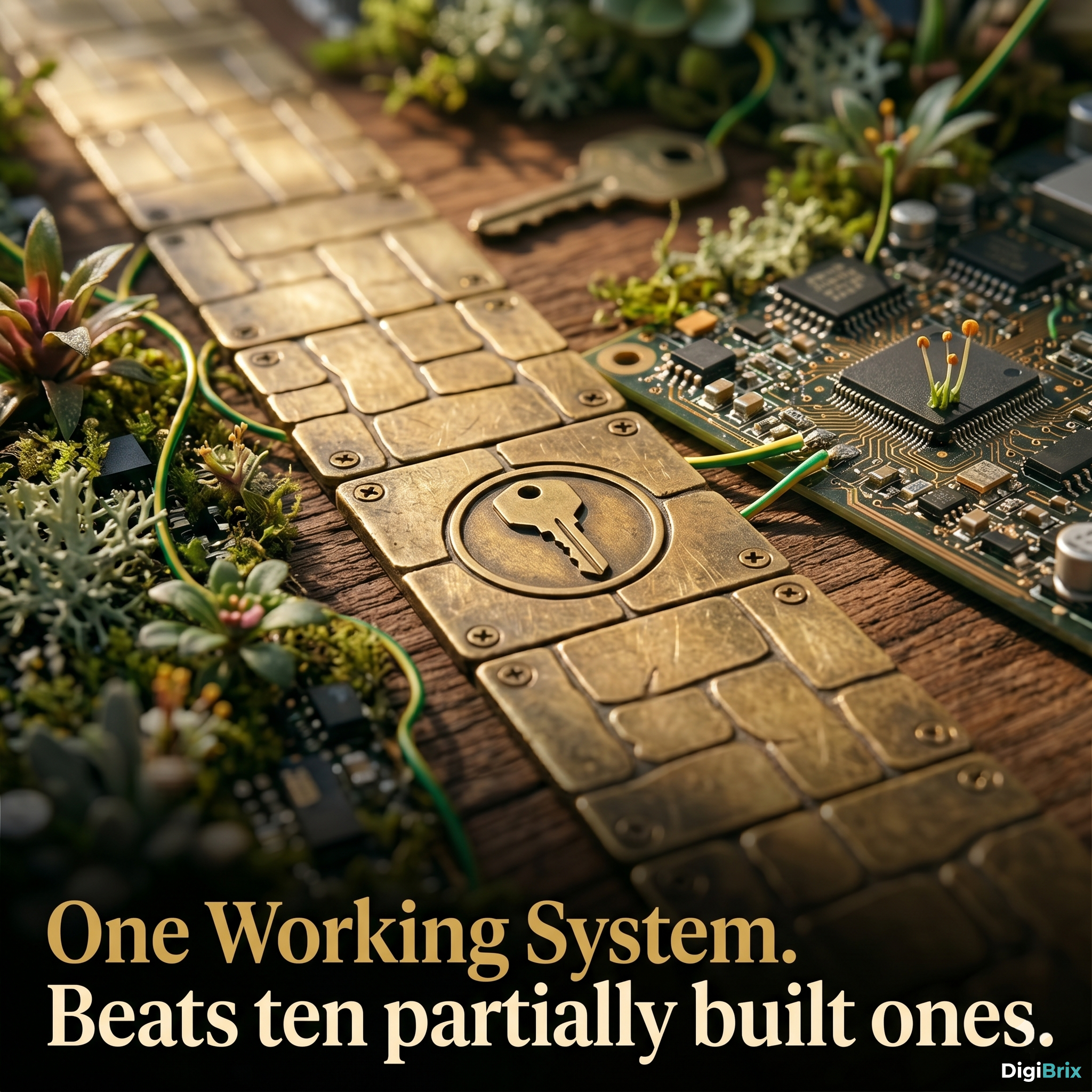
So does your business actually need full automation? No. Not yet. Maybe not ever, depending on what you are actually trying to solve. What you need first is one system — placed correctly, built carefully, and left alone to run.
That is not a compromise. For most solo operators navigating real constraints, it is the right call.
Key Takeaways
Full automation requires designing, building, and maintaining multiple systems at once — which often becomes its own full-time job for a solo operator.
One well-placed AI workflow produces immediate, measurable ROI. Four hours saved per week is over 200 hours per year.
The Placement Over Piloting Method starts with a single question: what one process, if running reliably, would reduce your workload most right now?
Full automation can remain a long-term direction. It is not a useful destination when you are managing everything yourself.
Specificity beats comprehensiveness. The fastest path to real ROI is the right system in the right place — not the most systems.
What Full Automation Actually Costs a Solo Operator
I want to be honest about what chasing full automation looks like in practice — because the version circulating on social media leaves out a few important details.
Full automation pursued comprehensively means designing multiple interconnected systems in parallel. It means troubleshooting integrations between tools that were not built to talk to each other. It means learning three or four new platforms at once, each with its own logic and limitations. And it means doing all of that while continuing to run your actual business.
For a solo operator or small team, that build process becomes its own full-time work. According to McKinsey research on AI adoption in small and medium businesses, the companies that report the lowest ROI from automation are consistently those that attempted enterprise-scale build-outs without the infrastructure — people, systems, or dedicated technical time — to support them. The intent was efficiency. The output was overhead.
What most small business owners end up with after an ambitious automation attempt: a collection of partially working systems. Integrations that need ongoing attention. A new maintenance category that did not exist before. And a persistent low-grade anxiety that something is probably broken and they just haven't noticed yet.
The net time savings are lower than expected, harder to measure, and slower to appear. That is not a failure of the tools. It is a failure of sequencing.
What the Data Actually Says About AI ROI
Here is what is interesting. When you look at how small business owners who are actually getting measurable returns from AI are operating, a clear pattern shows up.
They are not running full automation stacks. They are running one or two well-placed workflows.
A 2024 survey by Salesforce found that small business owners who reported high satisfaction with AI tools were nearly three times more likely to describe their approach as "starting with one specific use case" versus those who attempted broad implementation from the start. The satisfied group also reported faster time-to-value — weeks instead of months.
Separately, data from the U.S. Chamber of Commerce Small Business AI Index showed that among solo operators and businesses under five employees, the highest-reported ROI came from automating a single communication or administrative task — not from full workflow overhauls. The math behind this is straightforward. If you eliminate a process that takes four hours per week, you have just recovered more than 200 hours per year. At a modest client rate of $75 per hour, that is $15,000 in recovered capacity — from one system.
Compare that to a business that spent four months building an elaborate automation stack, still has three broken integrations, and cannot cleanly attribute any time savings because the systems interact in ways that are hard to track. The ambition was higher. The return was lower.
This is not a coincidence. It is a predictable outcome when you match the scale of the build to the actual capacity of the operator.
The Placement Over Piloting Method: What It Actually Looks Like
The Placement Over Piloting Method is built around a single premise: the right workflow in the right place produces better results than the most workflows in the most places.
Here is how it works in practice.
Step one is the placement audit. Before anyone touches a tool, we map the actual workflow — not the idealized version, but what the business owner is genuinely doing each week. Where is time going? What tasks repeat? What processes are genuinely predictable enough to automate? This is a diagnostic question, not a features question. It has nothing to do with what any particular AI tool can do. It has everything to do with what your business actually needs.
Step two is identifying the one. Not all workflows are equal candidates for automation. Some are too variable. Some depend on judgment that cannot be codified. Some are technically automatable but would produce worse outputs if automated, because the human touch is what makes them valuable. The placement audit surfaces the one workflow where automation would produce reliable, consistent results without degrading quality.
Step three is the careful build. One tool. One workflow. Built to run without your constant supervision. Tested until it is reliable. Not impressive on a slide deck — just consistently functional in your actual business.
Step four is measurement. You look at what the system actually saved. Real hours. Real tasks. Real capacity recovered. If it performed as expected, you leave it alone. If it did not, you adjust. Either way, you have a clean data point before you consider building anything else.
Then — and only then — do you decide whether to build a second.
I have worked through this process with enough small business owners to know that the first working system changes something beyond the time savings. When a business owner sees a workflow run reliably without their involvement, their relationship to the whole category shifts. AI stops being a concept they are trying to implement and becomes a tool they understand. That shift is worth as much as the recovered hours.
Frequently Asked Questions
What qualifies as a 'well-placed' AI workflow?
A well-placed workflow automates a task that is genuinely repetitive, predictable, and currently requiring your manual attention. It should produce the same output whether you are involved or not. If the task requires real judgment, client relationships, or contextual reading that changes each time, it is not yet a candidate.
How do I know I'm picking the right workflow to automate first?
Start with time. Which task is consuming the most hours each week for the least strategic return? That is usually the first placement candidate. It should be something that, if automated correctly, would produce no meaningful difference in output quality — only a reduction in your time investment.
Isn't full automation the goal eventually? Why deprioritize it?
Full automation can remain a long-term direction. The distinction is between direction and destination. Treating it as an immediate destination requires building multiple interconnected systems simultaneously — which, for solo operators, typically creates more work than it removes. Get one system running, measure the return, then sequence from there.
What if I've already tried this and the automation didn't hold?
That usually means the placement was off, not the tool. Either the workflow was too variable to automate reliably, or the system was built to impress rather than to run. A placement audit before the next build often surfaces exactly where the first attempt broke down.
How long does it take to see ROI from a single well-placed workflow?
The return is usually immediate. Once the system is running reliably, the time savings begin in the first week. Unlike a multi-system build where ROI is deferred and diffuse, a single workflow has a clear before-and-after. You know what you stopped doing, and you can measure what you did with that time instead.
Here Is What I Want You to Hear
You do not need an automated business. You need a business where the right processes run without you — and right now, that means identifying one of them.
Full automation is not a lie. For some businesses, in some contexts, with the right resources and the right technical support, it is a viable goal. But it is not where you start when you are operating solo, managing client relationships, doing your own marketing, and trying to grow something without burning out in the process.
Where you start is simpler, and it is more honest about where you actually are.
What one process, if running quietly and reliably in the background, would reduce your workload most meaningfully right now?
That question has a specific answer for your business. Finding it is what a placement audit does. And once you find it, build that one system. Let it hold. Measure what it actually produces. Then decide what to build next.
One working system is not a stepping stone. For most solo operators navigating real constraints on time, budget, and attention, it is the result.
Stephanie Ferguson is the founder of DigiBrix Consulting, a strategic AI consulting firm for small business owners and solopreneurs who have tried AI and feel stuck. Her Placement Over Piloting Method helps businesses identify the right AI workflows — not the most workflows — so they can recover time and build operational capacity without burning it down to build the system.