


digibrix BLOG
Why Your Second Automation Should Wait

The instinct is understandable. You identify a task worth automating, you automate it, and somewhere in the process you realize there are four more tasks that probably qualify. The logical move feels like doing them all at once. The logical move is also the one most likely to produce a system you cannot maintain.
This is not a statement about the limitations of AI tools. It is a statement about how humans learn systems they did not fully design. Automations introduce variables. Each variable changes what your output looks like and how your workflow behaves. When you add one variable at a time, you can observe its effect clearly. When you add five, you are operating on inference and hope.
The implementation that holds is simpler than most people expect: identify the single task in your business that carries the highest combined cost of time and money. Not the most interesting task, not the one that got the best demo in the tutorial you watched. The one that costs you the most to do by hand, week after week. Start there.
Run that automation for two to three weeks before you build anything else. Use a real task from your actual workload, not a test scenario. Watch what it produces. Learn where the output needs adjustment, what inputs produce the strongest result, and how the system behaves at its edges. You will learn things you could not have anticipated from the setup alone.
After two to three weeks of clean operation, you will have something more valuable than a running automation: you will have a standard. You will know what good output looks like from this system, which means you will know when a second automation is causing a problem and when it is not.
The second automation gets added after that. Not alongside the first. Not two days after the first goes live. After you understand the first well enough that it no longer requires your active attention to run correctly.
The businesses that get lasting value from AI are not the ones that deployed the most tools the fastest. They are the ones that understood each layer of their system before adding the next. That sequential approach is not a hedge against ambition. It is the structure that makes ambition sustainable.
One automation running well for six months produces more operational clarity than ten automations running uncertainly for six weeks. That is the version of AI adoption that earns its place in your business and stays.
#SmallBusiness #AIForBusiness #BusinessAutomation #QuietAI #WorkflowDesign #DigiBrix #AIStrategy #SmallBusinessOwner #OperationalClarity #BusinessSystems
Good AI Is Boring: Why the Best AI in Your Business Is the Part You Stop Noticing

There is a quality most people don't associate with AI success: invisibility.
The most effective AI implementations in small businesses are the ones that fade into the background. They run. The output arrives. The business moves forward. The owner does not think about the system because there is nothing to think about. No troubleshooting. No maintenance. No explaining to clients how it works. Just a quiet reduction in the effort required to do a specific, repeatable task.
This is not how AI gets marketed. The marketing is built around visibility. The impressive automations, the multi-step workflows, the dashboards with real-time status updates. These are the things that look good in demos and get shared in communities. They are also, in many cases, the implementations that create more overhead than they remove.
Visibility in an AI system is a diagnostic signal. When you find yourself checking whether your automation ran correctly, maintaining prompts that drift over time, or explaining your AI stack to someone as if it were an achievement, you are managing your AI rather than benefiting from it. You have replaced one kind of effort with a different kind of effort, one that often feels more technical and less satisfying.
Quiet AI operates differently. It is anchored to one specific, high-friction task in a workflow that already makes sense. The inputs are consistent. The output format is well-defined. The system requires almost no attention because there is almost nothing to go wrong.
This is the difference between impressive automation and useful automation. The impressive kind is something you build. The useful kind is something you forget about.
For a solo operator or a small business owner running without a team, the difference between these two types matters enormously. An impressive automation that requires maintenance is a part-time job with a technical job description. A useful automation that runs quietly is a small reduction in effort that compounds over weeks and months without requiring additional investment.
The diagnostic question is simple: do you find yourself thinking about your AI systems, or do you find yourself benefiting from them without thinking?
If you're thinking about them, they're probably in the wrong place, or they're not anchored to a clear enough problem, or both.
The goal is not a workflow you can screenshot and share. The goal is a Wednesday afternoon where something that used to take forty-five minutes is already done, and you didn't spend any time thinking about why.
That is what quiet AI produces. And it is much more valuable than anything that needs a dashboard.
#SmallBusiness #AIForBusiness #DigiBrix #QuietAI #EntrepreneurLife #BusinessOwner #WorkSmarter #CalmBusiness #SoloFounder
Why More AI Tools Aren't Making Your Business More Efficient

There is an assumption embedded in most AI adoption advice: that more tools mean more efficiency. The advice assumes the bottleneck is access. If you just had the right suite of tools, the savings would compound.
This assumption is wrong, and it is costing small business owners significant time.
More AI tools do not mean more efficiency. They mean more overhead. Each tool requires setup, prompting, output review, and occasional troubleshooting. Individually, each cost feels minor. Cumulatively, across five or six tools integrated loosely into a business's daily operations, the cost is a meaningful portion of the time the tools were supposed to save.
The reason this pattern persists is that each individual tool looks useful in isolation. The scheduling tool saves time on scheduling. The writing tool saves time on drafts. The summarization tool saves time on notes. But none of them are solving the single highest-friction problem in the business. They are reducing minor friction in multiple places while leaving major friction untouched.
The alternative is placement. Not broad AI adoption, but deliberate placement of AI in the one workflow where the friction is highest and the cost of that friction is most significant.
A business owner who identifies the single task that costs them the most repeatable effort each week, and places AI specifically there, will get more measurable value from one tool than they would from six tools applied loosely across their operation. The savings are concentrated. The overhead is minimal. And the output, because it is serving one specific, well-defined need, actually reaches the standard required to be useful.
This is the Placement Over Piloting principle. Not a rejection of AI tools, but a recognition that placement is what determines whether a tool creates value or creates overhead. The same tool, placed correctly, saves real time. Placed incorrectly, it adds to the list of things to maintain.
Most small businesses that are frustrated with AI are not using bad tools. They are using good tools in the wrong places, or in too many places at once.
The right question is not "which AI should I add?" It is "where is the one place in my business where AI would earn its keep, and what would that look like on a Thursday morning at nine o'clock?"
That specificity, more than any feature, is what separates AI that sticks from AI that gets cancelled at the end of the free trial.
#SmallBusiness #AIForBusiness #DigiBrix #QuietAI #PlacementOverPiloting #EntrepreneurLife #BusinessOwner #WorkSmarter #SoloFounder
Why AI Demos Work and Your Business Doesn't (Yet): The Context Gap Nobody Explains
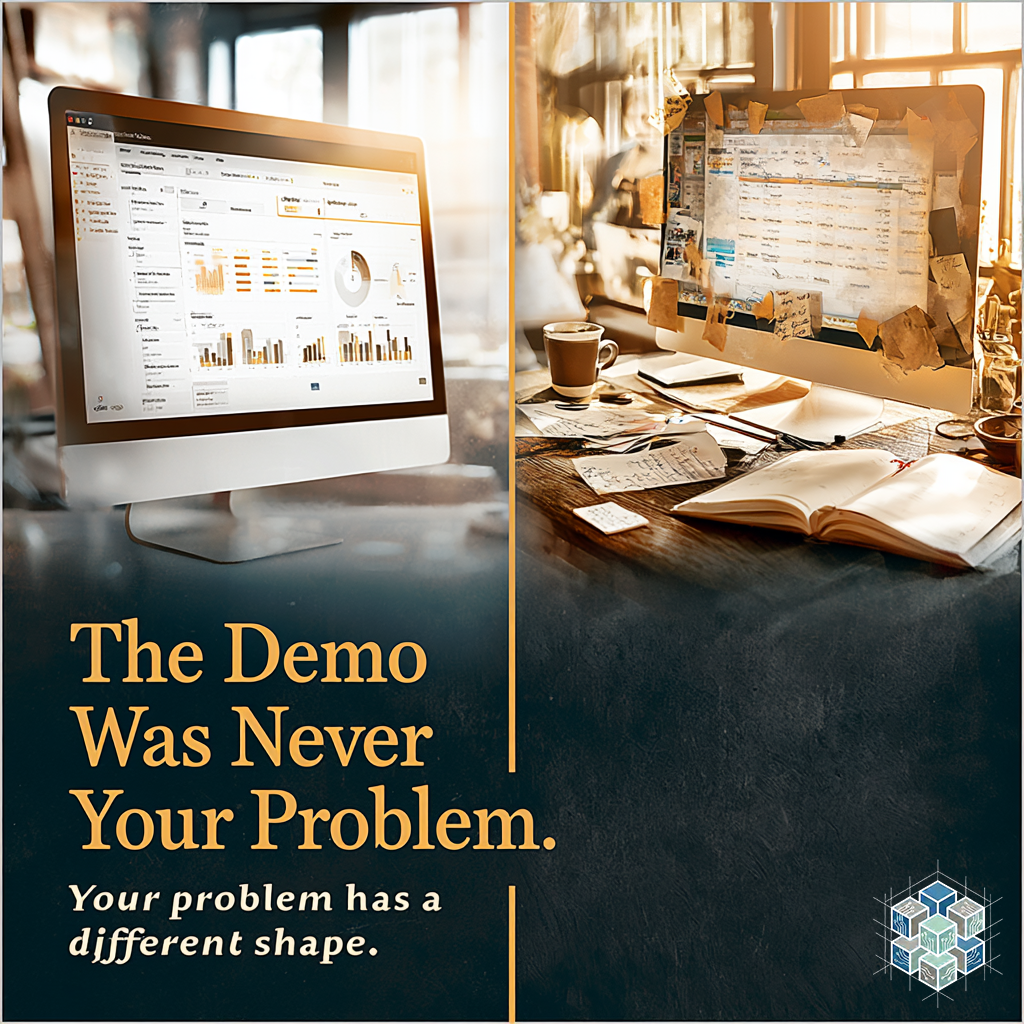
If you have tried AI and felt like it worked for everyone except you, there is a structural reason for that. It is not a personal failure. It is a product design reality.
AI demos are built to impress. This is not criticism; it is simply what they are for. A demo selects a use case that shows the tool performing well under favorable conditions. The input data is clean. The scenario is linear. The output is exactly what you would want, produced in a fraction of the expected time. The impression is that this is what using the tool is like.
It is not.
Using a tool inside a real business means dealing with ambiguous inputs. It means client data that doesn't fit a clean format. It means workflows with exceptions, history, and judgment calls embedded in them. It means limited time and limited patience for troubleshooting. It means the problem you're solving is probably not as well-defined as the demo's problem was.
The gap between those two realities is not a capability gap. It is a context gap.
When small business owners walk away from an AI tool feeling like it didn't work for them, the most common explanation they reach for is personal: they set it up wrong, or they needed more training, or they're just not technical enough. All of those explanations preserve the tool's reputation while placing the failure on the user.
A more accurate explanation: the tool was applied to the wrong problem, or to a problem that wasn't specific enough to be solvable.
There is a question that cuts through this. Before you choose any AI tool, before you watch any demo, ask yourself: what is the specific thing in my business that costs me repeatable effort every week? Not a vague area. A specific thing. Something that happens on a schedule, requires the same type of thinking, produces a similar output each time, and takes more time than it should.
That specificity is what makes AI useful. Not because specificity makes the tool better, but because it gives you a real standard for whether the tool is working. If you know what the output should look like, you can evaluate the tool's output against it. If you know how long the task should take, you can measure whether the tool is actually saving time.
Without that anchor, the demo succeeds and your implementation fails because they were never solving the same problem.
The fix is available to anyone. It requires no technical skill. It requires thirty minutes and a willingness to name one real friction point before you open the next browser tab. That friction point becomes your evaluation filter. Every tool either passes it or it doesn't.
That is a much smaller, more manageable conversation than "how do I get better at AI." And it produces real results instead of abandoned subscriptions.
#SmallBusiness #AIForBusiness #DigiBrix #QuietAI #EntrepreneurLife #BusinessOwner #ClarityFirst #WorkSmarter #SoloFounder
Is AI Fatigue Actually a You Problem? (No. And Here's What It Really Is.)

Every few weeks, a business owner tells me some version of the same thing. They have tried AI tools. Some of them worked, some of them didn't. But what lingers is not confusion about the tools. It is a specific, difficult-to-name feeling that they should be doing more, moving faster, adopting something they haven't figured out yet.
That feeling has a name. It is AI pressure. And it is manufactured.
The AI content ecosystem, meaning the newsletters, the LinkedIn thought leaders, the podcast hosts, the YouTube educators, runs almost entirely on urgency. The business model requires that you feel like today is the day you finally need to get serious. That you are one tool away from something important. That the businesses not moving right now are the ones who will regret it.
This is not an accident. Attention economics requires it. The moment a reader feels settled, they stop clicking. So the content machine keeps the pressure on. New tools arrive weekly. Comparisons get made to imaginary competitors who are, apparently, already fully automated. The language of inevitability gets deployed constantly. "AI will change everything." "You can't afford to wait." "The businesses that move now will win."
For a solo operator or a small business owner running a lean operation without a tech team, this content is not useful. It is noise that creates a low-grade sense of falling behind something that was never a real race to begin with.
There is a useful reframe here, and it is not motivational. It is structural.
The businesses that get lasting value from AI are almost never the fastest adopters. They are the most deliberate ones. They ignore most of the content. They identify one specific friction point in their operations. They find one tool that addresses it. They use it consistently for long enough to evaluate it honestly. And then they either keep it or they don't.
That is the entire process. It is boring, unglamorous, and dramatically more effective than anything a webinar will sell you.
The skepticism that many small business owners feel toward AI is not a liability. It is often the most reasonable response to an industry that has made urgency its primary product. Skepticism slows you down in the right places. It stops you from building systems around tools before you understand what problem the tools are solving. It keeps you from paying for subscriptions you don't use.
None of that is a failure to keep up. That is good business judgment operating correctly.
The question worth asking is not "am I using AI enough?" The question is "do I have one clear place in my business where AI is reducing real effort?" If the answer is yes, you are ahead of most. If the answer is no, the starting point is not more tools. It is a clearer problem definition.
That is a much quieter, much more manageable conversation. And it has nothing to do with keeping up.
#AIPressure, #DeliberateAI, #SmallBizAI, #AIAdoption, #TechSkepticism, #AIWithoutHustle, #FocusedAIUse